
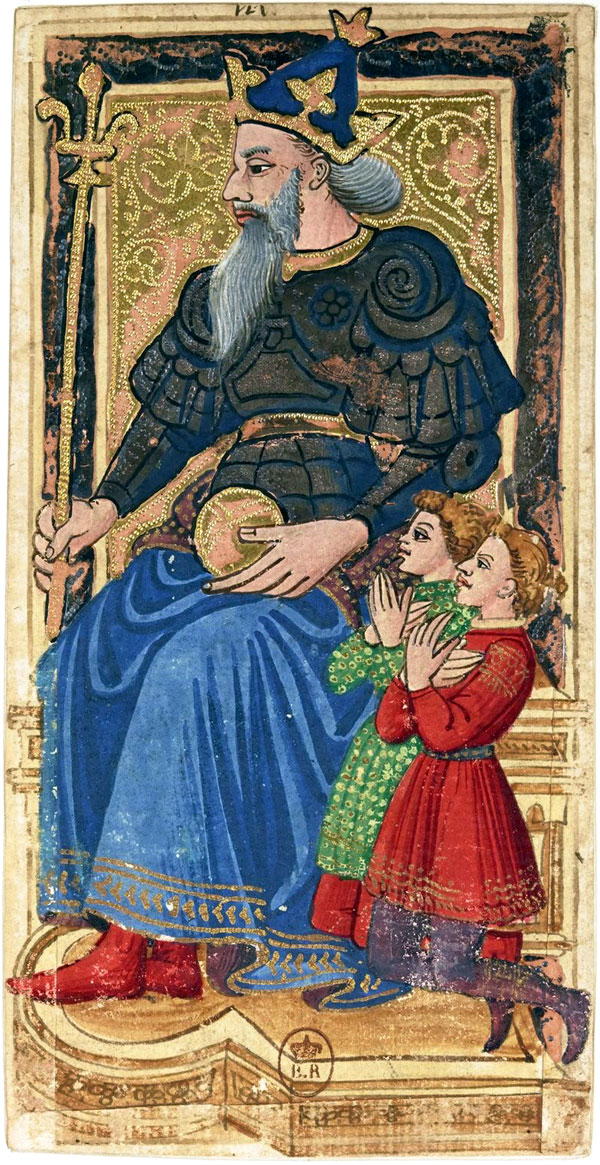
Before it was called tarot, and before it was used to tell the future or examine the inner psyche, it was a deck of playing cards.
Tarocchi originated in the courts of Milan and Ferrara, dukedoms in 15th-century Italy. It was also referred to as trionfi (“triumphs”), specifically for the point value in capturing the trump cards, which later became the Major Arcana cards. The earliest recorded mention of “trionfi” in connection to playing cards is from the 1440 journals of Giusto Giusti (1406-1483).

Tarocchi is played with a 78-card deck whose suits are the cups, swords, coins, and clubs. It’s a trick-taking game, like Hearts. In addition to being a fun pastime in which you could enjoy conquering your rival, they provided ruling families a chance to show off their immense wealth through these beautiful works of art.
Each card was one-of-a-kind, handcrafted. It’s thought that a few decks’ trump cards were modeled after members of the ruling families, a sort of homage to the artist’s patrons. It’s also thought that some decks were used as an educational tool to describe that era’s philosophical model of the cosmos by likening it to the journey of man.

Surviving Decks
Given how quickly shuffling can break down the edges of a card, and all that the world has been through, it’s frankly amazing to me that any decks have survived the past 600 years. But they have! Check it out:
The “E” series from Ferrara is on display at the Cleveland Museum of Art. Here’s the Fool card from it:

This surviving deck bears the Visconti emblem in several of the cards, so likely belonged to a member of that family. It dates to 1490. These are from the V&A Museum in London:


The Castello-Ursino deck dates to the 15th century and is representative of the Ferrarese style/typography. They’re hand-painted with tempera paint. These are owned by an anonymous Milanese collector who sometimes lends them out to small museum exhibits:

The Rothschild-Bassano deck dates to the 15th century and is commonly regarded as the oldest surviving tarocchi deck in the world. You can see them in The Louvre in Paris:

The Ercole d’Este deck is called so because his and his wife’s coat of arms features in the background of the court cards. So it’s a safe bet it belonged to him, which means it dates to about 1473. It’s on display at Yale University:

The Charles VI deck of about 1470 can be found in the French National Library. The featured image of this post is The Emperor card from that deck, and here’s The Fool:

Into Mystery has even more, if you’re curious.
Tarocchi is a card game still played today, which seems to have had many styles and rule interpretations. I’m working on a later post on how to play it, but to be honest, it’s pretty involved. Some versions are incredibly involved (with rules that forbid you from communicating with your playing partner and monetary penalties). It’s clear this was an engrossing “parlor game” that relied on skill and strategy!







Leave a Reply